Questions this page answers
Does a Facebook video transcript include the words written on the screen?
◆ No, and the question is worth separating before anything else, because it decides whether a transcript can stand in for watching. A transcript from this site is the spoken audio turned into text. Words that are burned into the video — titles, captions added in an editor, the text a creator writes on screen — are pixels, not sound, and the picture track is never decoded. The page's own verified measurement of that, run on 2026-10-13, put seven words on the picture of a 12.485 s clip and the transcript came back with zero of them, byte-identical to the same audio with a blank frame. The post caption under the video is a third thing again: it lives in the post, not in the file. Of the 17 readable pages behind these two phrases, none separates those three.
Why does adding music change the transcript so much?
◆ Because the recogniser has to listen through it. On three complete clips we added a synthetic four-chord music bed at 50% of the file's total energy, mixed in the way an editor's music track is mixed — under the voice, at the same moment. Wrong words went from 1 to 3 on an 18-word clip, 15 to 32 on a 68-word clip (22.06% to 47.06%), and stayed at 2 on a clean 33-word clip. Then we ran the same bed into the same files through three controls: re-encoding the audio alone, concatenating the bed after the speech at the same sample rate, and appending the bed as a raw byte copy. Those three changed the transcript by at most one word, and two of the three clips came back byte-identical. A bed that is merely present in the file is free; a bed that is mixed under the voice is what costs, and the cost is not a rounding error.
How much music is too much?
◆ In our measurement the answer is: less than you would guess, and there is a flat stretch. One 72.499 s source with 184 reference words, with the bed carrying 2%, 6%, 33% and 50% of the file's energy, scored 11.96%, 13.59%, 20.11% and 26.09% wrong. Nothing happened between 2% and 6% (22 and 25 wrong words, a three-word gap); the damage starts between 6% and 33% and keeps climbing. Swapping the same-level tonal bed for a percussive one — 120 BPM kick, 7 kHz hats, a bass line under 110 Hz, still no vocals — at the same 50% took it from 26.09% to 43.48%. None of the 17 pages puts a number on any of this; 10 of the 17 mention music and each of those 10 uses it as a word rather than a measurement.
Can I get a transcript from a private Facebook video?
◆ Not from a link, and only one of the 17 pages words the rule the other 16 run on: Supadata's “The link must open for a logged-out visitor.” We do not fetch links at all — this page takes a file. That is not a technicality: it is the only route that works for a group video, a friends-only post, an age-gated page or anything behind a login, because a file that opens on your own machine is a file the recogniser can read. Two of the 17 pages say something close to this (TicNote: “Most tools can only pull audio from a truly public video URL”; WayinVideo: “Private content that requires login cannot be accessed by the tool”), and neither turns it into a how-to. Downloading a video you have access to and transcribing the file is the step missing from most of this result set.
What length and size can it take?
◆ 30 minutes of audio and 512 MiB per job, which is the limit on this site rather than on any service. Among those 17 pages, the longest promise we found is one page offering “videos from 10 seconds to two hours long”, and three pages print no limit at all. A Reel is short enough that the limit never comes up; the file size limit does, because the video track is what makes a Facebook file big. You do not need the video: if your tool lets you save the audio only, you are carrying a fraction of the bytes into the same recogniser, and — measured on this site on 2026-10-18 — the output is bit-for-bit identical because the picture track is never decoded.
Why do the accuracy numbers on these pages not match each other?
◆ Because almost none of them is measured on Facebook video, or on anything they describe. 11 of the 17 readable pages print a percentage: 99% (facebooktotranscript.com, screenapp.io, happyscribe.com, speakwrite.com, kapwing.com), 98% (subgrab.com, castmagic.io, reccloud.com), 99%+ (rev.com), “typically 90%+” (supadata.ai). One page of the 17 mentions a test set, corpus, ground truth or sample size at all, and that mention is a paper about word error rates, not a description of the page's own testing. Our own reference numbers, all on the same site with the same model, came out at 5.56%, 6.06% and 22.06% wrong on three different clips — a 4x spread produced by the material, not by the tool. A single percentage on a page cannot be checked and cannot be compared, which is why this one gives a denominator with every number.
Is this the same job as facebook video to text?
◆ Yes, and that is why both phrases are in the page rather than in two pages. “Facebook video transcript” is the noun for the output; “Facebook video to text” is the verb for making it; the searches return largely the same pages, and 8 of the 22 distinct URLs across the two searches appear under both. The one difference worth knowing: the second phrase brings back more “how to” articles — Rev's and TicNote's guides, Vomo's three ways — and those are the only pages in the set that mention downloading the file as an alternative to pasting a link.
One music bed, three clips, five ways of putting it in the file
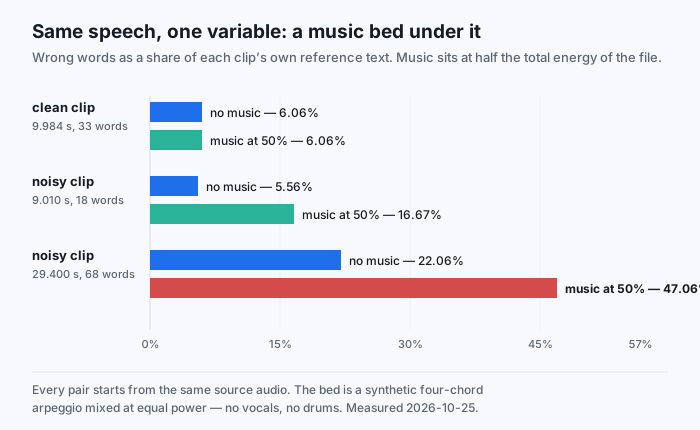
◆ The number that makes the rest of this page worth reading is the one in the middle bar: adding music is not a cosmetic change to a transcript. On the 29.400 s clip with 68 reference words it took 15 wrong words to 32 — 22.06% to 47.06% — and the errors it adds are the kind that survive a skim, because they are ordinary words in the wrong places: the line ending in flash his teeth kept that word but turned the surname before it into “conqueror”, where the dry file had the name right, and the closing line about a bath came back as “shampoo or a flickish bath” where the dry file had an ordinary reading of it.
◆ On the clean 33-word clip the same bed changed nothing: 2 wrong words with the music and 2 without, byte-identical transcript. ◆ That is the useful half of the finding. The bed does not add noise to a clean signal in any simple way; it removes the margin that a noisy signal was relying on.
The control that decides whether any of this means anything
An obvious objection: a file with music in it is a bigger file, and a bigger file could be worse for a dozen reasons that have nothing to do with music. So we built the same bed into the same three clips four other ways, and ran all fifteen files through the same page, one file per load.
| how the bed got into the file | E2, 18 words | E1, 68 words | A-clean, 33 words |
|---|---|---|---|
| nothing — source MP3 as it is | 1 — 5.56% | 15 — 22.06% | 2 — 6.06% |
| re-encoded to 128 kbit/s, no bed | 1 — 5.56% | 16 — 23.53% | 2 — 6.06% |
| bed concatenated after the speech, same sample rate | 1 — 5.56% | 16 — 23.53% | 2 — 6.06% |
| bed appended as a raw byte copy | 1 — 5.56% | 16 — 23.53% | 2 — 6.06% |
| bed summed in at equal power | 3 — 16.67% | 32 — 47.06% | 2 — 6.06% |
◆ Read the middle three rows as the noise floor of this material: one word on the 68-word clip, nothing at all on the other two, and on E2 and A-clean the transcript of the concatenated versions is byte-identical to the dry one (SHA-256 prefix f5631633e09f2b8b and 029ec35ff1c82c7e). A file that is 2 to 3 times longer and contains the same music changed nothing. ◆ Only the last row moves, and it moves by +2, +17 and 0.
What separates the last row from the others is not the music. It is that in the last row the music is simultaneous with the voice. The Facebook formats where a track plays under constant talking, rather than after it — a Reel with a track laid under the talking, a page video with a jingle, a live replay where the room noise never stops — puts the music in that row.
Each file was loaded once, in a real Chrome window with a throwaway profile, and read back from the page's own output box. The alignment is word-level DP against each clip's own reference text. The bed is synthetic — sine chords at 261.63, 329.63, 392.00 and 493.88 Hz under a 100 BPM pluck envelope — with no vocals and no percussion unless the row says so.
How much music, in one number
◆ “Half the energy” is a strange unit for a person editing a video, so here is the same experiment as a ladder. One 72.499 s source — six read-speech clips joined, 184 reference words — and the same bed, mixed so it carries a known share of the file's total energy. Everything else is identical.
| bed share of the file's energy | wrong words of 184 | word error rate | what changed against the row above |
|---|---|---|---|
| 2% | 22 | 11.96% | — |
| 6% | 25 | 13.59% | +3, inside the run-to-run band |
| 33% | 37 | 20.11% | +12 |
| 50% | 48 | 26.09% | +11 |
| 50%, percussive bed | 80 | 43.48% | +32 at the same level |
◆ Two things to take from that column. First, there is a flat stretch at the bottom: 2% and 6% are three words apart on 184, which is the size of this recogniser's own run-to-run variation on fixed audio — measured on this same site in October, where a byte-identical PCM copy of one file came back with two more wrong words than the MP3 it was made from. Below roughly a tenth of the energy, the music is not what is costing you. Second, the shape of the bed matters as much as its level: the last row is the same 50% and only the bed changed — a 120 BPM kick drum, 7 kHz hats and a bass line under 110 Hz instead of four sustained chords — and the error count went from 48 to 80.
◆ One more number from the same set, because it puts the two effects side by side on one source: cutting the same source to 11 s, 25 s and 40 s and running each with and without the 50% bed gave 3 vs 4, 5 vs 6 and 15 vs 19 wrong words. Shortening the file does not save you from the bed; the music's cost stays proportional while everything else shrinks.
What the 17 pages say about the audio, and what they leave out
Two searches on 2026-10-25 — facebook video transcript and facebook video to text — return 30 top-ten slots, 22 distinct URLs across 22 hosts. 17 could be fetched and read; turboscribe.ai answered 403 at three user-agent layers, skimming.ai and vomo.ai returned a 410 or a script shell. Everything below counts over the 17.
- ◇ 11 of 17 print an accuracy percentage. 1 of 17 says what it was measured over. The percentages are 99%, 99%+, “up to 99%”, 98%, “98%+”, “typically 90%+” and “90 to 95 percent”. The one page that uses the vocabulary of measurement — TicNote's “word error rates less than approximately 25%” — is quoting a paper about information retrieval, not describing a test it ran. 0 of the 11 states a denominator, a corpus size, or what audio the number came from.
- ◇ 0 of 17 prints a sample rate. 0 of 17 prints a bit rate. The one “MB” figure in the set is a reuse of ChatGPT's 25 MB file cap, on a page whose own upload limit is elsewhere. For a phrase about turning a Facebook file into text, no page in the set describes the file.
- ◇ 1 of 17 states the rule the other 16 pages are built on. Supadata: “The link must open for a logged-out visitor.” Four pages acknowledge the private-content problem in passing — WayinVideo (“Private content that requires login cannot be accessed by the tool”), TicNote (“Most tools can only pull audio from a truly public video URL”), Castmagic (“paste any public Facebook video URL”), SubGrab (“Videos Facebook only shows to logged-in viewers … it quietly serves a generic ‘Discover popular videos’ page”) — and only two of the four turn it into an instruction: TicNote tells you to download the file and upload that instead, and SpeakWrite tells you to “download the video, then use a transcription service”.
- ◇ 10 of 17 mention music. 0 of 17 measures it. Each of those 10 mentions is a clause in an accuracy disclaimer — “background music, crosstalk and strong accents lower accuracy”, “Reels: fast speech, music, and effects can lower accuracy”, “Clear audio with minimal background noise typically produces 90 to 95 percent accuracy”. None of the 17 says how much music, how loud, or what happens to the words when it is there. That is the gap this page fills, and the numbers above are what fills it.
- ◇ 6 of 17 sell speaker labels. 0 of 17 gives a number for them. “Speaker Diarization” as a feature tile (Speech2Text), “speaker labels” in the feature table (ScreenApp), “automatic speaker identification” (Happyscribe), “Multi-Speaker Detection” (VMEG). This site does not offer them, and the reason is the same one this page is about: a recogniser that cannot separate a music bed from a voice is not separating two voices from each other either.
- ◇ 3 of 17 say the video can be silent. Rev's guide is the only page that puts the platform's own behaviour next to the transcript question: “Facebook users watch 85% of videos without sound” — a figure Rev does not source either — and TicNote's checklist includes “Some Facebook videos post with no audio track, or play muted by default.” No page in the set works out what that means for the transcript: a video watched silently still has its audio, and the audio is what gets transcribed.
Counts come from the pages we could read on one day, checked line by line in context. Where a page returned 403, 410 or a script shell we say so and exclude it rather than guess. Exact-string hits were read before being called a mention — “music” inside a stock-footage library list, or “compression” inside a file-size tip, is not a statement about the audio.
Why a file and not a link
Fifteen of the 17 pages in this result set are built around pasting a link. That architecture is what produces the result set's most repeated caveat, and it is why the phrase “facebook video transcript” and the phrase “download the video first” keep meeting in the same articles.
Sitting on this side of that decision is a different set of trade-offs, and they are worth stating plainly. What you get: a group video, a friends-only post, a page that only opens when you are logged in, an age-gated clip — anything that plays on your own machine becomes transcribable the moment you have the file, because nothing has to be fetched from Facebook. What you give up: the convenience of pasting a URL, and the ability to batch a list of links. This page takes one file at a time and does not fetch anything.
The other consequence is quieter. When a page fetches a Facebook link on its own server, the audio it gets has been through whatever Facebook's player serves — and no page in the 17 tells you what that is: no bit rate, no sample rate, no container, no mono-or-stereo. When you hand over a file, you can look at the file. The measurements on this page are possible only in the second case, which is the honest reason they exist here and nowhere in the result set.
What these numbers do not cover
- The bed is synthetic and has no vocals. Four sine chords under a plucked envelope, and one percussive variant with a kick, hats and a bass line. No singing, no speech-like formants. A real Reel's track usually has a voice in it, and a sung voice is a harder signal than any bed on this page. The percussive row is the reason to believe the genre matters; it is not a measurement of a real song.
- No Facebook video was downloaded for this test. Nothing was fetched from Facebook, no account was used, and no real Reel, live replay or page video was transcribed. The audio is read speech from a public read-speech set, already an MP3 before we started.
- One run per file. 33 files, 33 page loads, each read once. The run-to-run band on fixed audio on this site is about ±1–2 words, which is why the flat stretch at 2–6% is reported as flat rather than as a trend.
- The 72.499 s source is six different recordings joined. Its 184 reference words come from six clips with different background noise levels, so its baseline of 11.96% already includes material that is harder than the clean clips. Do not compare across tables on this page; each table is internally paired.
- Energy is not loudness, and loudness is not what an editor calls “the music is low”. The shares are measured as power, before MP3 encoding, on files that were then encoded to 128 kbit/s. A person moving a music slider is adjusting something related but not identical.
- English, one speaker per clip, no overlapping voices. A Reel with two people talking over a track is a harder case than anything measured here, and this page does not measure it.
- We ran none of the 17 pages. Nothing was uploaded to them and no figure here describes their accuracy. Where a percentage is quoted, it is their claim about themselves, unverified.
Try it on a Facebook file you already have
The transcriber is at the top of this page and on the front page. It takes MP3, WAV, M4A, MP4, WebM, OGG, AAC or FLAC, up to 30 minutes of audio and 512 MiB per job, and the model runs inside your browser tab — the file is not uploaded. You get timestamped text out as TXT, SRT or VTT, one line wrapped at 42 display-width units. There are no speaker labels, and the picture track is not decoded, so on-screen words are not in the output. If your clip has a track laid under the voice, expect what the middle bar of the figure shows: the words will be there, and some of them will be wrong.