Six of the fourteen export SRT. None of them prints a number.
◇We ran five searches today — instagram transcript, instagram reel transcript, transcribe instagram video, instagram reels to text, instagram video to text — and read 14 pages: the nine tool and guide pages the searches returned, plus the five rivals named for this family. ◇All 14 answered HTTP 200; nothing in this count is a page we could not read.
◇Six of the 14 offer a subtitle file. This is the whole list, quoted.
| page | what it says about the subtitle file |
|---|---|
| https://ins-transcript.com/ | “export your transcript as TXT, SRT, or VTT files”; “.SRT — Most Popular Subtitle Captions … Standard subtitle files with sequential numbering and timecodes ( 00:00:01,200 --> 00:00:04,500 )”; “Every sentence and phrase includes millisecond-accurate timestamps”; “±5ms Precision Alignment”; “99%+ Word-Level Speech Recognition Accuracy” |
| https://subgrab.com/ | “Download the timestamped transcript as TXT, SRT or VTT”; “All formats include timestamps” |
| https://videototextai.com/ | “export as text, SRT, or VTT” |
| https://video2text.net/ | “Export options for TXT, SRT, VTT, and CSV”; “Timestamped transcripts for subtitles, editing, and review” |
| https://getthescript.app/ | “Download plain text, timestamped text, SRT, or VTT — or copy with simple [MM:SS] or detailed timestamps”; “Timestamped SRT & Subtitle Exports” |
| https://transcript365.com/ | “Export clean text, SRT, and WebVTT in 100+ languages”; “SRT — Timestamped subtitle files for video editors, caption workflows, and accessibility review” |
◇Not one of the six attaches a number to the file. Across all 14 pages there is no cue count, no line width, no reading speed and no words-per-minute — the four numbers that decide whether a subtitle file is usable — for any of their own outputs. ◇The closest any of the 14 comes is ins-transcript’s sample WebVTT: three cues for one speaker, timed 0.000–2.840, 2.840–5.920 and 5.920–9.150 seconds, printed next to the accuracy and alignment claims above. ◇That is a demo of a solo Reel with no count, no width and no test behind the claims.
◇The speaker question is sold the same way. Four of the 14 offer labels or diarization — transcriptdownloader (“speaker labels and diarization”, “Accurate speaker separation for podcasts, interviews, and multi-speaker content”), video2text (“Speaker diarization to identify different speakers clearly”), saveto (“accurately distinguish and label content from multiple speakers”) and reeltexts, which links to a speaker-attribution guide — and none of the four attaches a number to the separation. ◇Two of the 14 mention overlapping speech at all: reeltranscriptguide in a guide title, gettranscribe in a disclaimer (“Music, overlapping speakers, strong accents, and recording quality can affect results”). ◇The words duet, remix, two voices, two speakers and two people appear on none of the 14.
◇Seven of the 14 print a transcription accuracy percentage — 99%+, 95%+, 98%, 99%, 99.9%, 95%+, 96%+ — and none of the seven attaches a word count, a clip count or a description of a test. ◇Reeltexts links to guides that quote numbers of their own (17.2% screen coverage across five Reels, 92 of 97 caption breaks), and those pages are not among the 14 we read.
◇The results turned over while we were reading them. Eight of the 14 pages had not appeared in the searches we ran for this family on 10-23 and 10-24; of the 25 domains those two days produced, only videototextai is still in the results, at fourth place in one of five searches. ◇Today’s top three are ins-transcript.com, first in four of the five searches, then reeltexts.com and reeltranscriptguide.com.
The test: five arrangements, five exports, one button each
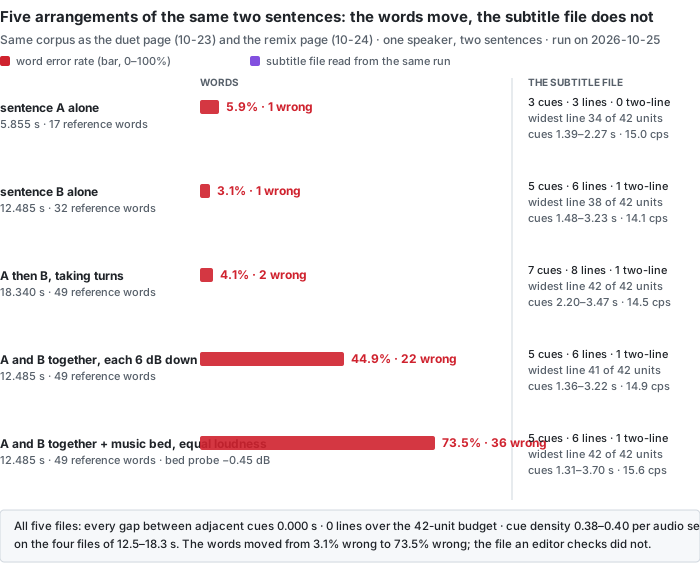
◆One variable: how the two sentences are arranged. ◆The corpus is the one our duet page used on 10-23 and our remix page on 10-24, unchanged — one speaker reading two sentences, A at 5.855 seconds with 17 reference words, B at 12.485 seconds with 32. ◆The bed is the same synthesised one, at equal loudness to the program it sits under; the bed-only probe measured −0.45 dB against the program file, the constant MP3 end-padding offset the remix page recorded, and the loudest mix peaked at −12.83 dBFS, so nothing is clipped on the way in.
- The export is the page’s own. ◆After each run finished we pressed the page’s own
Export .SRTbutton and captured the bytes the button produces — the same file a visitor downloads. ◆The cue count, line widths, durations, gaps and reading speeds on this page are measured on those bytes. - The width budget is this site’s rule. ◆Read from this site’s export code: a full-width character counts 2 and everything else 1, against a budget of 42 units per line. ◆Another exporter wraps differently; the numbers here describe this export, not a standard.
- Five files, five runs. ◆Every file was built with ffmpeg — one decode, one encode — at 16 kHz mono 24 kbit/s and handed to the live page in a real Chrome window with a fresh profile, one file per page load, on 2026-10-25. ◆The run is recorded in
data/instagram-srt-two-voices-2026-10-25.csv. - The word counts are the page’s own. ◆Whitespace words in the transcript the page printed, next to the reference counts. ◆The error rates are the DP-aligned scores the duet and remix pages recorded for these same bytes — the five transcripts came back byte-identical today, so the scores carry over unchanged.
| file | arrangement | bytes | audio | page’s clock | cues | lines | widest line | cue durations | fastest line | words out | errors | word error rate |
|---|---|---|---|---|---|---|---|---|---|---|---|---|
| solo-a.mp3 | sentence A alone | 18,044 | 5.855 s | 27.9 s (cold) | 3 | 3 | 34 of 42 | 1.39–2.27 s | 15.0 cps | 17 | 1 of 17 | 5.9% |
| solo-b.mp3 | sentence B alone | 37,916 | 12.485 s | 14.7 s | 5 | 6 | 38 of 42 | 1.48–3.23 s | 14.1 cps | 32 | 1 of 32 | 3.1% |
| a-then-b.mp3 | A then B, taking turns | 55,520 | 18.340 s | 14.0 s | 7 | 8 | 42 of 42 | 2.20–3.47 s | 14.5 cps | 48 | 2 of 49 | 4.1% |
| a-and-b.mp3 | together, each 6 dB down | 37,916 | 12.485 s | 8.3 s | 5 | 6 | 41 of 42 | 1.36–3.22 s | 14.9 cps | 32 | 22 of 49 | 44.9% |
| a-and-b-bed0.mp3 | together + bed, equal loudness | 37,916 | 12.485 s | 8.5 s | 5 | 6 | 42 of 42 | 1.31–3.70 s | 15.6 cps | 32 | 36 of 49 | 73.5% |
◆Read the clock column as single observations: the cold row carries the 63 MiB model and the 21.5 MiB runtime the page downloads on a first visit, and a 12-second clip carries the fixed cost of a whole job, so none of these numbers is a rate. ◆Read the two solo rows as the quiet end of the scale rather than a measurement of it: one error each sits inside the ±2-word jitter band our call page established on 10-24, and the same sentence-B file has come back with one error on four days and two on a fifth.
The words moved from 3.1% wrong to 73.5% wrong. The file did not.
◆Line the five files up by what the recogniser did to the words and by what it did to the file, and the two columns disagree. ◆The words: 1 error of 17, 1 of 32, 2 of 49, 22 of 49, 36 of 49 — 5.9%, 3.1%, 4.1%, 44.9%, 73.5%. ◆The file: 3, 5, 7, 5 and 5 cues; 3, 6, 8, 6 and 6 lines; widest line 34, 38, 42, 41 and 42 of the 42-unit budget; cue durations spanning 1.39–2.27, 1.48–3.23, 2.20–3.47, 1.36–3.22 and 1.31–3.70 seconds; fastest line 15.0, 14.1, 14.5, 14.9 and 15.6 characters per second.
◆Normalise by the clock and it is flatter still. ◆On the four files of 12.5 to 18.3 seconds, cue density runs 0.38 to 0.40 cues per audio second: the file with two voices starting together gets the same 0.40 per second as the second sentence alone, and the file where the two take turns gets 0.38. ◆The cue count tracks the clock, not the number of people talking. ◆Words per cue sit at 5.7, 6.4, 6.9, 6.4 and 6.4 across the five files.
◆Nothing in the file crosses a line an editor would check. ◆Of the 29 lines across the five exports, 0 exceeds the 42-unit budget and two sit exactly on it — similes drawn from eating, and its results in the taking-turns file and Beef looming before us, similes drawn from in the bed file. ◆The fastest line in any file reads at 15.6 characters per second, under the 17 cps line our timestamped page drew on 10-17, where 5 of 36 cues went over it. ◆The shortest cue, 1.31 seconds, sits above the 833 ms floor that page cites and the longest, 3.70 seconds, under its 7-second ceiling. ◆And all 20 boundaries between adjacent cues measure 0.000 seconds — the same zero-gap pattern that page found across 36 cues, and the pattern a subtitle editor is told to merge or stretch.
◆So the damage in a duet Reel is invisible in the file an editor opens. ◆A 73.5%-wrong transcript arrives as 5 cues, 6 lines, one two-line cue, a 42-unit line and a 3.70-second cue — a fast-talking Reel by every shape measure we have, and wrong in 36 of 49 words.
The cue boundary does not know where the speakers change
◆Take the taking-turns file, the mildest two-voice shape: two creators, one after the other, 2 errors of 49 reference words. ◆The first voice’s sentence ends at 5.855 seconds. ◆The cue that spans that moment runs from 4.650 to 7.180 seconds, and its text is welcome his gospel. He tells us that — the last three words of one voice and the first four of the other, joined by a full stop, in one cue, with no separator and no speaker marker. ◆The next cue, at this festive season of the year,, is pure second voice. ◆The hand-off is a full stop in the middle of a cue, and nothing else in the file marks it.
◇Four of the 14 pages we read sell speaker labels or diarization, and this site does not do it: the transcript is one paragraph, and in an overlap every cue is a blend. ◇Not one of the four prints a number for the separation, and not one of the 14 says what its subtitle file does when two people talk.
In the overlap file, every cue is a blend
◆Put the two voices together and the cues stop belonging to anybody. ◆The first two cues of the overlap file read The calculator is the apostle of the Middle Classes, here glad to welcome Mrs. Gospels, — 32 words out where 49 went in, with 17 of the reference words absent from the transcript, as the duet page counts on the same bytes. ◆The recogniser is not dropping one voice and keeping the other; it is producing a third text that belongs to neither, and the subtitle file timestamps it as smoothly as it timestamps a solo read.
◆Add the bed and the blend gets stranger while the shape stays put: The cell filter is a possible little classless, a year-glad, two-year-old, and a cost-post. ◆Five cues, six lines, one two-line cue, widest line exactly 42 units, fastest line 15.6 characters per second — and 36 of 49 reference words wrong. ◆The output holds at 32 words, the same as without the bed, on the page’s whitespace count — what changes is which words, and every one of them is wrong. ◆The recogniser fills the music with text of its own, “a possible little classless” among it, and the scorer’s hyphen-splitting token count for this row reads 36 against the whitespace count of 32.
The same five files, the same bytes as the days before
◆All five transcripts came back byte-identical to the runs of the same files on previous days: ae9a38cfd60f2206 for sentence A alone, matching 10-23; 6c759c1b6c2d4429 for sentence B alone, matching 10-19, 10-22 and 10-23; 13c667886b99fe1a for taking turns, matching 10-23 and 10-24; 10f440c61f17ede8 for the overlap, matching 10-23 and 10-24; 539e0d6a627c0cbd for the overlap with the bed, matching 10-24. ◆The error rates on this page are the scores those days recorded for these bytes, so the words column and the file column are the same run, not two runs.
◆One environment note, reported rather than smoothed: this batch ran with crossOriginIsolated false, the flag the 10-23 Teams page recorded for one of its rows. ◆The five outputs matching the earlier runs byte for byte is the evidence that the flag did not move the result in this batch.
What this page cannot do
- Take an Instagram link. There is no URL box. Save the Reel, then drop the file on the front page and press
Export .SRT. ◇All 14 pages we read take a link or a URL. - Fetch anything from Instagram. Nothing was pasted, no account was used, no page of Instagram’s was read for this page, and no Reel was downloaded.
- Separate two people. Our benchmark set holds one clean human voice, and both streams in this test are that one speaker reading two sentences. ◆This measures what a second speech stream does to the transcript and the subtitle file, not how well distinct human voices can be told apart, and the transcript carries no speaker labels.
- Tell you what your duet will export. One run per file. ◆The counts are what these five files did on this day; a different mix, a different day or a different exporter can move a count, and one control on a previous day did exactly that.
- Run any of the 14 pages. The quotes are what the pages print, quoted. ◇We uploaded nothing to them and we are not saying their exports lose words — only that none of the 14 prints a cue count, a line width or a reading speed for its own output.
- Translate. The model transcribes the language it is told is spoken; it does not convert one language into another.
What our numbers do not cover
- One run per file, one day, one machine. ◆Five files, five runs, on 2026-10-25, in a fresh Chrome profile. ◆That is enough to show what the second voice does to the shape of the file; it is not a sample of duets, of remixes or of editors.
- The clips are 5.855 to 18.340 seconds. ◆Real Reels run longer, and a longer file gives the chunker more room to differ. ◆The cue density we measured, 0.38 to 0.40 per audio second, is a fact about these five files.
- The mixtures are our own builds. ◆We summed the two streams and the bed ourselves with ffmpeg, one decode and one encode per file. ◆A real duet export and a real remix mix will differ in detail; nothing here was recorded off a duet.
- The bed is synthesised. ◆Three sustained sine tones and a low pulse: no vocals, no drums above 1 kHz, no sidechain ducking, no master-bus compression — the same caveat our TikTok page and remix page carry for the same bed. ◆A real trending track has all of those, so this is one bound on the bed’s effect, not its average.
- The width budget is ours, not a standard. ◆The 42-unit line, the full-width-character rule and the 0.5-second cue floor all come from this site’s export code. ◆Another exporter wraps and clamps differently, so our geometry numbers describe our export and cannot be read as a claim about anyone else’s file.
- The lone-voice baseline moves between days. ◆Sentence B alone came back with one error on 10-19, 10-22, 10-23 and today, and with two on 10-24. ◆Every comparison on this page is same-batch for that reason, and the two solo rows sit on one error each — inside the ±2-word jitter band our call page established on 10-24.
- The batch ran with crossOriginIsolated false. ◆The five transcripts came back byte-identical to earlier runs of the same files, which is the evidence that the flag did not move the output here.
- ◇Some searches returned pages that are not tools. ◇Of the 25 result positions the five searches returned, 8 were not transcription tools — three video-editor pages, two Chinese-language how-to posts, two encyclopedia entries and one blog post — and they are not counted in the 14. ◇All 14 pages we count answered HTTP 200 and were read in full.
- The search volumes are printed as supplied. instagram transcript 2,400 and instagram reel transcript 1,000 are US monthly averages given to us, both marked low competition. ◇We did not measure them and we did not estimate any figure that was not given.
Try it on a duet you already have
Save the duet, the remix or the reaction Reel to your device and drop the file on the front page. ◆If the two people take turns you will get both of them in order, in one run of text, with one cue straddling the hand-off. ◆If they start together, expect most of the words to be wrong — and expect the SRT to look perfectly ordinary while it is, so read the text before you cut it to picture. ◆The recognition runs in your browser tab, so the file never leaves the machine. ◆The ceiling is 30 minutes of audio and 512 MiB per job.
Questions this page gets asked
What does the SRT of a duet Reel look like?
Ordinary. In our run of five arrangements of the same two sentences - one voice, one voice, taking turns, overlapping, overlapping over a music bed - the subtitle file held 3 to 7 cues, its widest line ran 34 to 42 of the 42 display-width units this site budgets, cue durations ran 1.31 to 3.70 seconds, the fastest line read at 14.1 to 15.6 characters per second, and every gap between adjacent cues measured 0.000 seconds. Over the same five files the words moved from 3.1% wrong to 73.5% wrong. The file an editor checks does not show that.
Do any Instagram transcript tools print subtitle numbers?
Six of the 14 pages we read offer SRT or VTT export. None of the 14 prints a cue count, a line width or a reading speed for its own output. One page, ins-transcript.com, prints a sample WebVTT with three timed cues for a single speaker, next to a 99%+ word-level accuracy claim and a plus-or-minus 5 ms alignment claim, with no test described. Four of the 14 sell speaker labels or diarization and none attaches a number. None of the 14 uses the words duet, remix, or a phrase for two voices in one file.
How many cues does a duet Reel get?
In our run, cue density was flat across arrangements: the two-voice file that starts together came back with 5 cues over 12.485 seconds, 0.40 per audio second, the same as the second sentence alone; the taking-turns file came back with 7 cues over 18.340 seconds, 0.38 per audio second. The cue count tracks the clock, not the number of people talking.
Does the SRT show where one speaker stops and the other starts?
No. There is no separator and no speaker marker. In the taking-turns file the third cue runs 4.650 to 7.180 seconds and the hand-off falls at 5.855 seconds, so one cue holds the end of the first voice's sentence and the start of the second's, joined by a full stop: welcome his gospel. He tells us that. In the overlapping files every cue is a blend of both voices. Four of the 14 pages we read sell speaker labels or diarization; none of them prints a number, and this site does not label speakers.
Is the subtitle file legal to drop into an editor?
In our run the shape stayed inside the common band: 0 of 29 lines over the 42-unit width budget, with two lines sitting exactly on it; the shortest cue was 1.31 seconds, above the 833 ms floor our timestamped page cites, and the longest 3.70 seconds, under the 7 second ceiling; every gap between adjacent cues was 0.000 seconds, the same zero-gap pattern that page measured on 36 cues. Legal shape is not accuracy: in the worst row 36 of 49 reference words came back wrong.
Can I paste an Instagram link into this site?
No. This page transcribes a file you already have: save the Reel, then drop the file on the front page and export the SRT from the result. All 14 pages we read take a link or a URL. What you get here in exchange is that the recognition runs inside your browser tab and the file is never uploaded. The ceiling is 30 minutes of audio and 512 MiB per job.