Questions this page gets asked
What happens to the second voice in a duet Reel transcript?
On this page, two speech streams that take turns came back at 4.1% word error rate - two errors of 49 reference words, the same as their two solo runs added together - and both sentences survived in order as one run of text. The same two streams starting together came back at 44.9%, with 17 of the 49 words absent from the transcript. One voice per channel came back at the same 44.9%: the page sums the channels before recognition, so separate channels do not keep the voices apart.
Do any Instagram transcript tools label the speakers?
Nine of the 27 pages we read claim speaker labels, diarization or speaker recognition - musely.ai, screenapp.io, wayin.ai, kapwing.com, elevenlabs.io, dictationer.com, apify.com, saveto.ai and speakapp.com - and not one of the 27 prints a number for what the second voice costs: no survival rate, no per-voice accuracy, no diarisation error rate. The two voice counts in the family, six at musely and thirty-two at elevenlabs, are capability counts, not measurements. Our own output carries no speaker tag either: a two-person file comes back as one run of text.
Should I save a duet with the two voices in separate channels?
No. We built the file that way on purpose - the first voice in the left channel, the second in the right, nothing shared - and it came back at 44.9% word error rate, the same 22 errors and the same 17 absent words as the two voices starting together. The page's own audio path decodes the file and renders it through a one-channel buffer, so the channels are summed: the second channel is not dropped, it is added.
Does it matter if the second creator is mixed quieter?
Not in our run. The first voice then the second at equal level came back at 4.1%, and the same arrangement with the second stream 6 dB down - measured exactly 6.0 dB in the file - also came back at 4.1%. Which single word went wrong moved between the two rows, and with one run per file we read that as the recogniser's own coin, not as an effect of the level.
Can I paste an Instagram link into this site?
No. This page transcribes a file you already have: save the Reel, then drop the file on the front page. All 27 pages we read take a link or a URL. What you get here in exchange is that the recognition runs inside your browser tab and the file is never uploaded. The ceiling is 30 minutes of audio and 512 MiB per job.
How many words is a two-person Reel transcript?
At the 148.2 words a minute our own reference material runs at - 229 words over 92.7 seconds - a 30-second exchange between two people holds about 74 words, and one wrong word is 1.35 points on that. In the arrangement where the two voices start together, 17 of 49 words were absent and 5 more came back misheard, which is a third of the text; at Reel lengths that is the difference between a transcript you can quote and one you have to re-watch the video for.
Nine pages sell speaker labels for the Reel that has two people in it
◇A duet, a collab post or a reaction Reel is not an exotic file: it is one file with two speech streams in it, and it is one of the formats people most want transcribed. ◇Nine of the 27 pages we read answer that with a speaker-label claim. ◇This is the whole list, not a selection.
| page | what it claims |
|---|---|
| musely.ai | “Speaker diarization for up to 6 voices per clip”; “99.1% transcription accuracy on clear speech”; “a clean, speaker-labeled transcript with timestamps in under 60 seconds” |
| elevenlabs.io | “Scribe labels up to 32 speakers with word-level timestamps”; “Every transcript arrives with speaker labels, word-level timestamps, and audio event tags” |
| screenapp.io | a “Speaker Diarization” entry in its own feature menu; “The transcript comes back with timestamps and speaker labels a few minutes later” |
| saveto.ai | “It can accurately distinguish and label content from multiple speakers”; “Intelligent identification of multiple speakers” |
| wayin.ai | “Transcript speaker labeling” and “Full transcript with speakers” on its plan table; “Timestamped & Speaker-Label Transcript” |
| kapwing.com | “Multi-speaker Detection” — “Multiple speakers are automatically detected in your videos for precise dubbing” |
| apify.com | “Returns AI transcription with speaker diarization, word-level timestamps, detected language, SRT and WebVTT subtitles” |
| dictationer.com | an “Identify Speakers” toggle in the tool itself |
| speakapp.com | a “Speaker Recognition” chip beside its “99% Accuracy” and “50+ Languages” chips |
◇Not one of the nine attaches a number to the claim. ◇There is no survival rate, no per-voice accuracy, no diarisation error rate anywhere on the 27. ◇The two voice counts in the family — six at musely, thirty-two at elevenlabs — are capability counts, not measurements: they say how many labels the product will print, not how many of the second speaker's words survive to be labelled.
Five pages name the two-voice problem, and all five leave it in words
◇The problem itself is not a secret in this family. ◇Five of the 27 describe it, in prose, with no figure attached. ◇The sharpest of the five is getthescript, whose Instagram page has a FAQ for exactly the collab case — and then tells you its own output will not attribute either side.
| page | what it says about two voices |
|---|---|
| getthescript.app | “Collab posts and remixes confuse the output. Why?” — “Two audio layers (original + remix voiceover) overlap. Transcribe the original Reel separately for a clean script, then note the remix commentary by hand.” And: “Overlapping speech is the top accuracy killer.” And, on its own product: “Speakers are not auto-labeled today.” |
| screenapp.io | “a clear voiceover transcribes well, while loud background music or overlapping speech drops accuracy” — then points at a per-language accuracy page that is not about voices |
| gettranscribe.ai | “Music, overlapping speakers, strong accents, and recording quality can affect results.” |
| subclip.app | “heavy background music, overlapping voices, and compression artifacts can reduce accuracy” |
| dictationer.com | “For best results, use videos with clear voices and minimal music overlap.” |
◇The one page that describes the collab case best also draws the map of what is missing: getthescript tells you to transcribe the two sides separately and note the second one by hand. ◇That is a workaround for a number nobody printed. ◇And on channels — the one arrangement that would keep the two voices apart — not one of the 27 says anything: the only channel words on the 27 belong to a different tool (screenapp's audio-quality checker prints “{n} channels”), to an upload tip (getthescript's “Compress to MP4 with mono audio”) and to an error string buried in one page's code (wayin's “The audio channel type is not supported.”).
The test: two streams, six arrangements, one variable at a time
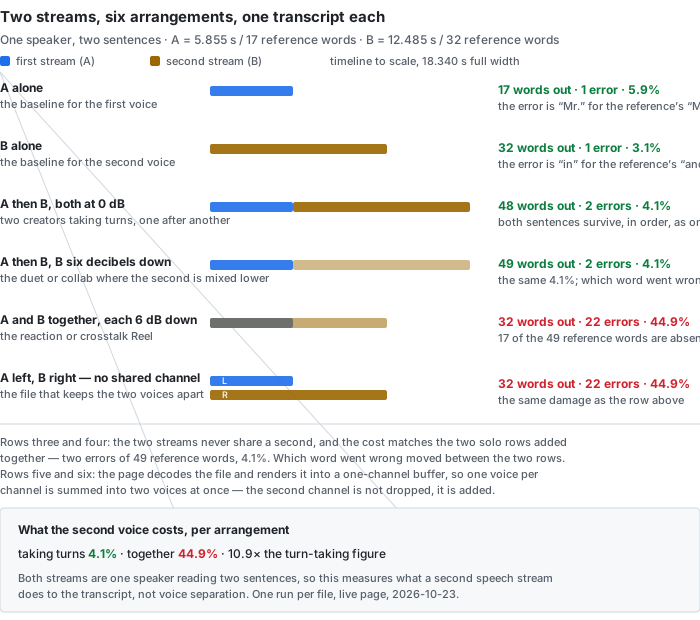
◆Two streams, one variable: how the second voice arrives. ◆Both streams come from our own benchmark set and are the same speaker reading two different sentences — A is 5.855 seconds with 17 reference words, B is 12.485 seconds with 32. ◆Everything below was built with ffmpeg, handed to the live page in a real Chrome window with a fresh profile, one file per page load, and the page's own output was read back, counted and hashed. ◆The run is recorded in data/instagram-two-voices-2026-10-23.csv.
- The two baselines. ◆Each stream alone, as the source files exist: A is 18,044 bytes, B is 37,916, both MP3 at 16 kHz mono.
- Taking turns. ◆A then B, concatenated with no gap and no overlap, both at 0 dB — two creators talking one after another in one Reel. ◆18.340 seconds, 55,520 bytes.
- Taking turns, second one down. ◆The same file with B mixed 6 dB lower — the duet or collab where the second creator sits under the first. ◆B's level in the file measures exactly 6.0 dB below its level in the row above.
- At the same time. ◆A and B starting together, each stream 6 dB down before they are summed — the reaction or crosstalk Reel, and the same arrangement we ran for our Google Meet page on 10-16. ◆12.485 seconds.
- One voice per channel. ◆A in the left channel, B in the right, nothing shared, lossless PCM. ◆Both channels were verified byte-exact against the solo files before the run: the left channel is A followed by pure silence, the right channel is B for the full length.
| file | arrangement | bytes | page's clock | output | errors | word error rate |
|---|---|---|---|---|---|---|
| solo-a.mp3 | A alone | 18,044 | 23.8 s (cold) | 88 chars / 17 words | 1 of 17 | 5.9% |
| solo-b.mp3 | B alone | 37,916 | 10.2 s | 174 chars / 32 words | 1 of 32 | 3.1% |
| a-then-b.mp3 | A then B, both 0 dB | 55,520 | 12.3 s | 264 chars / 48 words | 2 of 49 | 4.1% |
| a-then-b-quiet.mp3 | A then B, B 6 dB down | 55,520 | 9.8 s | 263 chars / 49 words | 2 of 49 | 4.1% |
| a-and-b.mp3 | together, each 6 dB down | 37,916 | 6.8 s | 186 chars / 32 words | 22 of 49 | 44.9% |
| split-lr.wav | A left, B right | 799,118 | 8.3 s | 184 chars / 32 words | 22 of 49 | 44.9% |
◆The word error rates are DP-aligned against the 49 reference words (17 + 32), with substitutions, deletions and insertions each counting one — the same scorer this site's accuracy work uses. ◆The word counts in the output column are the page's own whitespace words; one row needs a footnote: at equal level the model wrote rose-beef where the reference has roast beef, which is one whitespace word and two scorer tokens, so that row shows 48 words out against 49 in. ◆Read the clock column as single observations: the cold row carries the 63 MiB model and 21.5 MiB runtime the page downloads on a first visit, and a 12-second clip carries the fixed cost of a whole job, so none of these numbers is a rate.
Taking turns costs the two solo runs added together
◆When the two streams never share a second, the second voice is not a problem at all. ◆Both turn-taking rows came back at 4.1% — two errors of 49 reference words — which is the two solo rows added together (one error each). ◆Both sentences survived, in order, as one run of text:
| row | the page's own output, in full |
|---|---|
| A then B both 0 dB | “Mr. Quilter is the apostle of the middle classes, and we are glad to welcome his gospel. He tells us that at this festive season of the year, with Christmas and rose-beef looming before us, similes drawn from eating, and its results occur most readily to the mind.” |
| A then B B 6 dB down | “Mr. Quilter is the apostle of the middle classes, and we are glad to welcome his gospel. He tells us that at this festive season of the year, with Christmas and roast beef looming before us, similes drawn from eating in its results occur most readily to the mind.” |
◆Per voice: A's sentence kept 16 of its 17 words in both rows (the one error is the model's “Mr.” for the reference's “MISTER”), and B's kept 31 of 32. ◆The quieter row is not the safer row: with one run per file, the only difference between the two rows is which single word went wrong — at equal level B's error is rose-beef for roast beef, 6 dB down it is the same in-for-and the solo row already makes. ◆We read that as the recogniser's own coin, not as an effect of the level.
◆What the output does not have is any mark of where one speaker stops and the other starts. ◆The two sentences come back as one paragraph, in order, with nothing between them — the same shape our SRT measurements found on the eight-clip set, where 36 cues carried 0 speaker labels.
At the same time, 22 of the 49 words are wrong
◆The reaction Reel is the other shape, and it is where the second voice stops being free. ◆With the two streams starting together, each 6 dB down, the page came back at 44.9% — 22 errors of 49 reference words, 10.9 times the turn-taking figure. ◆Per voice, A kept 10 of 17 words and B kept 17 of 32: of the 49, 27 are the right word, 5 are misheard and 17 are absent.
| row | the page's own output, in full |
|---|---|
| together each 6 dB down | “The calculator is the apostle of the Middle Classes, here glad to welcome Mrs. Gospels, beef looming before us, similes drawn from eating, and its results occur most readily to the mind.” |
| A left, B right no shared channel | “The culture is the apostle of the Middle Classes, here, glad to welcome Mrs. Gospels, beef looming before us, similes drawn from eating, and its results occur most readily to the mind.” |
◆Both rows print the same arithmetic — 22 errors, 44.9%, the same 10-of-17 and 17-of-32 split per voice — and different words. ◆That instability is part of the finding: we ran the same arrangement on 2026-10-16 for the Google Meet page and it came back at 42.9%, one error away, with yet another garble. ◆In the overlap regime the damage is stable and the exact text is not, so a reader cannot know in advance which half of the Reel will survive.
◆Scale it to a Reel: at the 148.2 words a minute our reference material runs at, a 30-second two-person exchange holds about 74 words, and about a third of that is 26 words you would have to recover by re-watching the video. ◆One wrong word on a 74-word transcript is 1.35 points; 26 missing words is 35.
One voice per channel is summed, not selected
◆The channel-split file is the arrangement a careful editor would reach for: keep the two voices in separate channels, and let the tool pick. ◆It does not pick. ◆The file came back at 44.9%, the same 22 errors and the same 17 absent words as the two voices starting together — and the output is not one of the solo transcripts either, so no channel was dropped on the floor.
◆The mechanism is in the page's own code, and it is short: the audio path decodes the file with the browser's decoder, then renders the buffer through a one-channel offline context and reads that single channel. ◆A file with one voice per channel is therefore summed into two voices at once before recognition starts. ◆The second channel is not dropped; it is added.
◆Two practical readings, both narrow. ◆First: splitting the channels does not protect the second voice, so the collab Reel getthescript answers with “transcribe the original Reel separately” is answering the right question. ◆Second: the bytes are not the issue either — the channel-split file is 799,118 bytes, 21 times the overlap file, and it took 8.3 seconds against 6.8 on the page's clock, one run each.
What this page cannot do
- Take an Instagram link. There is no URL box. Save the Reel, then drop the file on the front page. ◇All 27 pages we read take a link or a URL.
- Fetch anything from Instagram. Nothing was pasted, no account was used, no page of Instagram's was read for this page, and no duet file was downloaded.
- Label the speakers. The output is one run of text with no speaker tags, so a duet comes back as one voice — the arrangement is yours to make, not the tool's.
- Separate two people. Our benchmark set holds one clean human voice, and both streams in this test are that one speaker reading two sentences. ◆This measures what a second speech stream does to the transcript, not how well distinct human voices can be told apart.
- Run any of the 27 pages. The quotes are what the pages print, quoted. ◇We uploaded nothing to them and we are not saying their tools lose words — only that none of the 27 prints a number for the second voice.
- Translate. The model transcribes the language it is told is spoken; it does not convert one language into another.
What our numbers do not cover
- One run per file, one day, one machine. ◆Six files, six runs, on 2026-10-23, on a two-core machine with a fresh profile. ◆That is enough to show what the arrangements cost; it is not a sample of duets, of editors or of remixes.
- The mixtures are our own builds. ◆We concatenated, attenuated and summed the two streams ourselves with ffmpeg — one decode and one encode per file. ◆A real duet export, a real collab remix and a real reaction mix will differ in detail; nothing here was recorded off a duet.
- Both streams are one speaker. ◆A and B are the same reader, two sentences of the same passage; B's row also carries the light pink noise of its condition in our set. ◆The turn-taking rows measure stream collision, not speaker separation, and the overlap rows measure acoustic overlap, not diarization.
- The turn-taking rows differ by one word. ◆4.1% against 4.1%, with the error moving between them. ◆With one run each, that is a coin, not a level effect, and we do not claim quieter is safer.
- The overlap regime is not reproducible word for word. ◆The same arrangement measured on 10-16 came back 42.9% with different words wrong. ◆We report today's file, and the difference, and we do not pick the nicer number.
- The clocks are not rates. ◆The cold row carries the model download; the rest are single warm runs of 12- and 18-second clips, where the fixed cost of a job dominates. ◆The published steady state on this site is 18.1 to 20.5 seconds per audio minute, from files of 13 to 1,610 seconds.
- ◇Some results were not readable. ◇Of the 28 URLs the two searches and the five named rivals produced, proactor.ai answered HTTP 403 to a Chrome user agent and is not counted. ◇All fractions on this page are over the 27 pages we could read.
- The search volumes are printed as supplied. instagram transcript 2,400 and instagram reel transcript 1,000 are US monthly averages given to us. ◇We did not measure them and we did not estimate any figure that was not given.
Try it on a duet you already have
Save the duet, the collab or the reaction Reel to your device and drop the file on the front page. ◆If the two people take turns you will get both of them, in order, as one run of text; if they talk at once, expect about half the words to be missing, and split the file by hand before you upload it. ◆The recognition runs in your browser tab, so the file never leaves the machine. ◆The ceiling is 30 minutes of audio and 512 MiB per job.