Eight of the fifteen export SRT or VTT. None of them describes a window.
◇We ran six searches today — instagram transcript, instagram reel transcript, transcribe instagram video, instagram reels to text, instagram video to text, instagram reel transcript timestamps long video — and read 15 pages: the nine tool and guide pages the searches returned, plus the five rivals named for this family and transcriptmagic.com. ◇All 15 answered HTTP 200; nothing in this count is a page we could not read. ◇Of the 30 result positions the six searches returned, 9 were distinct tool or guide pages, some of them in more than one search; the other 10 positions were not tools — three video-editor pages, two Chinese-language how-to posts, an encyclopedia entry, a developer-forum post, two Instagram-guide posts and one Reel analytics page.
◇Here is every count this page makes, with the denominator spelled out.
| what we counted | pages | reading |
|---|---|---|
| exports SRT or VTT | 8 of 15 | ins-transcript, subgrab, videototextai, video2text, reeltranscript, getthescript, transcript365, transcriptmagic |
| mentions timestamps | 10 of 15 | the eight above plus reeltexts, transcriptdownloader |
| prints a length cap | 3 of 15 | 60 minutes, 10 hours, and a 5-minute free tier |
| describes a 30-second window, a chunk boundary or a seam | 0 of 15 | the three hits for “window” are a refund window, a browser on Windows, and a translation pipeline’s cue windows |
| says what happens to silence inside a file | 0 of 15 | the three hits for “silence” are pricing policies — no speech, no charge |
| says audio is skipped or dropped | 0 of 15 | the hits are example copy (“skipping the 3-second hook”) and a translation pipeline |
◇The eight that export a subtitle file, quoted. This is the whole list.
| page | what it says about the subtitle file |
|---|---|
| https://ins-transcript.com/ | “export your transcript as TXT, SRT, or VTT files”; “SRT — Most Popular Subtitle Captions … Standard subtitle files with sequential numbering and timecodes ( 00:00:01,200 --> 00:00:04,500 )”; “SRT files come with precise timecodes aligned to the speech, making them immediately compatible with video editors” |
| https://subgrab.com/ | “Download the timestamped transcript as TXT, SRT or VTT”; “Plain text for notes and blogs, SRT for video editing subtitles, or VTT for web players” |
| https://videototextai.com/ | “Refine the text, translate it, use AI chat, and export as text, SRT, or VTT” |
| https://video2text.net/ | “Export options for TXT, SRT, VTT, and CSV”; “SRT&VTT Standard subtitle formats, perfect for adding captions to your videos” |
| https://reeltranscript.com/ | “Timed SRT/VTT exports are available with a minute pack or Pro”; “If timing is available, a minute pack or Pro can unlock SRT/VTT subtitle exports” |
| https://getthescript.app/ | “Download plain text, timestamped text, SRT, or VTT — or copy with simple [MM:SS] or detailed timestamps”; “Download pristine SRT, VTT, Word, and Excel files ready for editing suites with no watermarks” |
| https://transcript365.com/ | “Export clean text, SRT, and WebVTT in 100+ languages”; “SRT — Timestamped subtitle files for video editors, caption workflows, and accessibility review” |
| https://transcriptmagic.com/ | “Export SRT, VTT, TXT, PDF, or JSON for your pipeline”; “Word-level timing accurate to the frame” |
◇Not one of the eight attaches a number to the file — no cue count, no line width, no reading speed, no words-per-minute — and not one of the 15 says where a cue boundary falls when a file runs past one recognition window. ◇Two of the 15 hedge on timestamps in a way this page can confirm from the other side: reeltranscript prints “Timestamps appear when the transcription provider returns them” and “with timestamps when the transcription provider returns reliable timing data”, while transcriptmagic prints “Word-level timing accurate to the frame”. ◇On the default English path the provider returns no timestamps at all, and the cue times are arithmetic — which is what the rest of this page measures.
◇The three length caps, quoted: ins-transcript “Support for Reels, Videos, IGTV, and Stories up to 60 Mins” and “Unlike competing tools that cut off at 2 minutes, our system comfortably transcribes long-form tutorials, interviews, and webinars up to a full hour”; video2text “Each file can be up to 5 GB, with a maximum media length of 10 hours”; reeltranscript “Videos up to 5 minutes” on the free tier and “Videos up to 60 minutes” on the paid one. ◇Context we did not count, because these are not tool pages: later.com “Instagram Reels can now be up to 20 minutes long”, and reeltranscriptguide “Reels recorded in-app: 3 minutes for most accounts, with reporting in 2026 placing some accounts at 15-20 minutes”. ◇A 20-minute Reel is forty windows on the default path.
◇The only seam numbers we found are in a length-limit article by reeltexts, a sixteenth page we read through a link on one of the 15. ◇Its own words: “Speech models of this family read about thirty seconds of audio at a time and then continue with the next stretch, so a boundary between stretches is a place to check”; “One segmentation was measured for this page, on a 36.2-second clip: 0 to 29.28 seconds, then 29.28 to 36.00 seconds”; “On the one clip measured here that crosses a boundary, two identical runs returned the same text with no phrase repeated and nothing missing. One sample is not a rule.” ◇It also defines the defect we were looking for: “A phrase emitted twice, or a short run of words missing between two segments, is what a boundary defect looks like.” ◇And it measured the population the caps are sold against: 11 public Reels, the longest 178.7 seconds, the median 83.0 seconds, none over 5 minutes. ◇A median Reel crosses two or three 30-second windows, and the only seam measurement we found across the 16 pages we read is one clip, once, by that page’s own admission.
The test: five files across the window boundary, plus one file of pure silence
◆One variable: how long the file runs. ◆The corpus is the one this site has scored since 10-19 — one synthesised sentence (A, 9.984 seconds, 33 reference words), two clean read-speech clips from LibriSpeech (C1 at 5.855 seconds with 17 words, C2 at 4.815 with 11), the same read speech with pink noise mixed in at two levels (D1 12.485 s / 32 words and D2 9.900 s / 25 words at amplitude 0.06; E2 9.010 s / 18 words and E1 29.400 s / 71 words at 0.14) — and the reference is the dataset’s own transcripts, not our typing.
- The export is the page’s own. ◆After each run finished we pressed the page’s own
Export .SRTandExport .VTTbuttons and captured the bytes the buttons produce — the same files a visitor downloads. ◆The cue counts, boundaries, spans and reading speeds on this page are measured on those bytes. - Five files, five runs, one control. ◆Every file was built with ffmpeg — one decode, one encode — at 16 kHz mono 24 kbit/s, 0.5 seconds of digital silence between segments, and handed to the live page in a real Chrome window with a fresh profile, one file per page load, on 2026-10-26. ◆A sixth file, 35 seconds of pure digital silence, was run the same way as the silence control. ◆The run is recorded in
data/instagram-long-reel-2026-10-26.csv. - The model is the default one. ◆English on the standard tier is Moonshine base, 63 MiB plus a 21.5 MiB runtime, and the page says so out loud while it downloads: “Downloading the English speech recognition model (63 MiB, plus the 21.5 MiB runtime — both cached after the first run)”. ◆Every number on this page is that tier. ◆The larger tiers return model timestamps and were not measured here.
- The word counts are the page’s own. ◆Words out is the whitespace count of the transcript the page printed. ◆The error rates are DP-aligned scores on normalised text — lowercased, punctuation stripped, apostrophes split — so the scorer counts
Quilter’sas two words where the page counts one, and its hypothesis for sliver is 87 against the page’s 85. ◆Reference counts use the same normalisation.
| file | bytes | audio | windows | page’s clock | reference words | words out | errors | word error rate | SRT cues | caption clock | window boundaries |
|---|---|---|---|---|---|---|---|---|---|---|---|
| sliver.mp3 | 96,668 | 32.054 s | 2 | 42.8 s (cold) | 86 | 85 | 8 of 86 | 9.3% | 13 | 0.000–32.050 | 30.000 |
| twowin.mp3 | 135,656 | 45.039 s | 2 | 23.7 s | 118 | 117 | 9 of 118 | 7.6% | 17 | 0.000–45.040 | 30.000 |
| twowin-again.mp3 | 135,656 | 45.039 s | 2 | 31.3 s | 118 | 117 | 9 of 118 | 7.6% | 17 | 0.000–45.040 | 30.000 |
| silent.mp3 | 172,916 | 57.469 s | 2 | 29.5 s | 65 | 66 | 3 of 65 | 4.6% | 10 | 0.000–57.470 | 30.000 |
| fourwin.mp3 | 253,808 | 84.449 s | 3 | 40.3 s | 207 | 201 | 28 of 207 | 13.5% | 29 | 0.000–84.450 | 30.000; 60.000 |
◆The VTT of every file carries the same cue count and the same start and end times as its SRT, to the millisecond — the two exports are one clock. ◆Read the page’s clock column as single observations: the cold row carries the 63 MiB model and the 21.5 MiB runtime a first visit downloads, and a 32-second clip carries the fixed cost of a whole job, so none of these numbers is a rate. ◆Read the two quiet rows the same way the call page taught us to: one or two errors sit inside the ±2-word jitter band this material shows, and small differences on this page are not effects.
The same segment crossed the same seam four times and lost no word
◆Window boundaries in the exported file land at exactly 30.000 s and 60.000 s: the last caption of a window ends on the round number and the first caption of the next window starts on it, in all five files. ◆Behind that round number the audio cut is the whole window, not a word boundary inside it. ◆The page’s own code tries to cut at the last word boundary at least 2 seconds inside the window, and on this path it never fires: the estimated captions carry no model timestamp, so the cut falls back to the full 30 seconds — a window is handed over whole, and the next window starts exactly where the clock says it does.
◆Five of the six boundaries cut through ongoing speech, and four of the five are the same speech: the light-noise segment D2 runs from 22.154 to 32.054 seconds — 9.900 seconds, 25 reference words — and the 30.000-second boundary falls inside it in four runs. ◆Here is what the seam cost, per run, on the same 25 words.
| run | D2 matched | D2 substituted | D2 dropped | what the substitutions are |
|---|---|---|---|---|
| sliver.mp3 | 21 of 25 | 4 | 0 | grave→great, Leighton→Layton, rocky→wanky, Ithaca→isaka |
| twowin.mp3 | 22 of 25 | 3 | 0 | grave→great, Leighton→Layton, rocky→wacky |
| twowin-again.mp3 | 22 of 25 | 3 | 0 | same three as twowin, byte for byte |
| fourwin.mp3 | 22 of 25 | 3 | 0 | same three as twowin |
◆Zero dropped words in all four crossings, and the substitution count moves between 3 and 4 — a one-word difference on the same audio, inside the jitter band, which is why we will not call it a seam effect. ◆No phrase is emitted twice anywhere in the five transcripts: zero repeated four-word sequences in any file, against the one defect shape the competitor’s article names. ◆And the second shape — a short run of words missing between two segments — is what the fifth boundary does not show either, for the reason the next paragraph gives.
◆The fifth speech-cutting boundary, at 60.000 seconds in fourwin.mp3, falls inside the heavy-noise segment E1 (55.049 to 84.449 seconds, 71 reference words). ◆That segment came back with 53 words matched, 15 substituted and 3 dropped — the three dropped words sit at an estimated 59.2, 60.9 and 65.4 seconds by proportional position, one on each side of the seam and one five seconds past it, and the substitutions mangle every proper noun in the segment: Linnell read as Linel, Birket Foster as Mr. Burke fosters, Carker as Crocker, sitter as sater, Shampooer as shampoo, Turkish as flickish. ◆Nothing was chopped, repeated or dropped at the boundary itself — the captions run straight through it, how delicate an expression. Linel's pictures are a sort of up-guards — and the losses are singletons scattered through the noisiest segment in the batch, not a run at a seam. ◆We have no second run of E1 without a seam to compare against, so we report the shape and stop there.
◆The same file twice came back byte-identical: twowin.mp3 and its copy twowin-again.mp3 returned the same transcript (d6c98d9fe01b2d00) and the same SRT (f399f4e67e430f5a), and the four runs that share a first window share its captions exactly — window 1 of sliver, twowin and fourwin is 12 cues, 82 words, 448 characters, ending at 30.000. ◆The tail window behaves the same way: sliver’s second window is 2.054 seconds long and holds one caption, Of wanky isaka., while twowin’s second window opens with the same three reference words given fifteen seconds of room, Of wacky Ithaca, he tells us that — two substitutions against one, on the same words, a one-word difference we treat as jitter.
The caption clock is arithmetic: seven words a cue, spread by character count
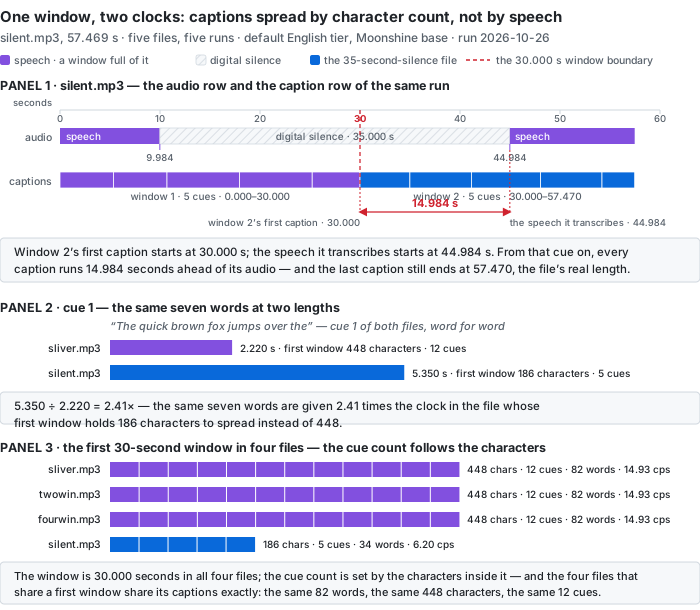
◆On the default path the model returns text and no timestamps, so the page estimates each caption’s timing itself: seven words to a cue, each cue’s share of the window in proportion to its characters, boundaries rounded to two decimals. ◆A window’s captions therefore always fill the window exactly — 30.000 seconds of window, 30.000 seconds of captions — whatever the audio inside it did. ◆The 57.469-second file with 35 seconds of digital silence in the middle shows what that means.
◆Its first window, 0.000 to 30.000 seconds, holds 9.984 seconds of speech and 20.016 seconds of silence. ◆The speech came back with one error in 33 words, and its five captions were spread across the whole half minute: The quick brown fox jumps over the runs 0.000 to 5.350 seconds and the last caption of the window, old stone bridge by the water., ends at exactly 30.000. ◆The same sentence’s first seven words, as cue 1 of sliver.mp3 — whose first window holds 448 characters — run 0.000 to 2.220 seconds. ◆The same seven words, 2.41 times longer on the clock, because their window had 186 characters to spread instead of 448.
◆The second window is worse. ◆It runs 30.000 to 57.470 seconds and holds 14.984 seconds of silence followed by 12.485 seconds of speech — the speech came back with one error in 32 words — and its first caption, He tells us that at this festive, starts at 30.000 while its audio starts at 44.984. ◆The captions run 14.984 seconds ahead of the audio from that point on, and nothing in the file says so: the last caption ends at 57.470, the file’s real length, so an editor checking the tail sees a tidy file.
◆Reading speed follows the character count, not the speech. ◆Across the five files every caption reads between 6.06 and 15.32 characters per second, and the whole-file rate between 6.35 and 14.82: the four files whose windows are full of speech read at 13.24 to 14.82 characters per second, and the file with 35 seconds of silence in it reads at 6.35 — all ten of its captions between 6.06 and 6.41, its own words spread thin. ◆And all 81 boundaries between adjacent cues, across all 86 cues in the batch, measure 0.000 seconds: the estimated clock tiles the file with no gaps, which is the shape a subtitle editor is told to fix by hand.
◇One of the 15 pages prints the honest version of this: reeltranscript says “Timestamps appear when the transcription provider returns them”. ◇On the default English path the provider returns none, and the cue times are the arithmetic above; the larger tiers on this site do return model timestamps, and we did not measure them.
Silence inside the file is decoded, not skipped — unless the whole window is silent
◆The rule in the page’s code is conservative: a 30-second window is skipped only when every 20 ms frame of it sits below an absolute floor, so a window is never dropped for being merely quiet. ◆Our 35 seconds of digital silence decode to exactly 0.00000000 RMS in all 1,550 twenty-millisecond frames, and the speech next to it measures 0.101368 — 127 times the floor. ◆So the silence in silent.mp3 is literally silent by the site’s own test, and neither of that file’s windows was skipped, because each one also held speech. ◆The silence bought the clock nothing: it was spread over like text, and the captions ran 14.984 seconds ahead of the audio from the first cue of the second window on.
◆The control file answers the other half of the rule. ◆A 35-second file of pure digital silence — 105,524 bytes, the same MP3 settings — went through the same page on the same day, and the worker’s own progress messages, read off the page, were segments 2, then segment 1 skipped at 30, segment 2 skipped at 35, then done, 35 seconds counted silent, 0 chunks. ◆The output was 0 characters, a 1-byte SRT and a 9-byte VTT — the header and nothing else — and the recogniser invented no sentence for the dead air. ◆That is the whole of what silence does on this path: inside a window it is timed like speech, and a window of nothing but silence is dropped whole.
What this page cannot do
- Take an Instagram link. There is no URL box. Save the Reel, then drop the file on the front page and export the SRT from the result. ◇All 15 pages we read take a link or a URL.
- Fetch anything from Instagram. Nothing was pasted, no account was used, no page of Instagram’s was read for this page, and no Reel was downloaded.
- Tell you what your Reel will export. One run per file, on one day, on one machine. ◆The counts are what these five files did on 2026-10-26; a different day or a different build can move a count, and the same segment already moves by one word between runs.
- Measure the larger tiers. Every number here is the default English tier, Moonshine base. ◆The tiers above it return model timestamps, which is a different clock, and we did not run them.
- Say the seams are safe in general. ◆Four crossings of one segment cost zero words; a fifth seam, in the noisiest segment we have, dropped three scattered words. ◆That is six boundaries in five files, not a law about long files.
- Run any of the 15 pages. The quotes are what the pages print, quoted. ◇We uploaded nothing to them and we are not saying their exports lose words — only that none of the 15 prints a number for a window, a seam or silence.
- Translate. The model transcribes the language it is told is spoken; it does not convert one language into another.
What our numbers do not cover
- One run per file, one day, one machine. ◆Five files and one control, on 2026-10-26, each in a fresh Chrome profile. ◆That is enough to show what a window boundary does to these files; it is not a sample of Reels.
- The clips are our builds. ◆One speaker, read speech, 0.5 seconds of digital silence between segments, pink noise mixed in at two amplitudes, one decode and one encode per file at 16 kHz mono 24 kbit/s. ◆A real Reel carries a music bed, two voices, platform re-encoding and room tone — our duet, remix and duet-SRT pages measure the first two.
- The silence is digital. ◆Exact zeros, decoding to 0.00000000 RMS in every frame. ◆A real quiet passage carries room tone, and whether it lands under the site’s absolute floor is not something this batch measures — we only show that a window with any speech in it is decoded whole.
- The dropped-word positions are proportional estimates. ◆The 59.2, 60.9 and 65.4-second positions for E1’s three dropped words come from word index over segment length, not from forced alignment, so treat them as “one each side of the seam and one past it” rather than as exact times.
- The batch ran with crossOriginIsolated false. ◆The five transcripts’ repeat control — the same file twice, byte-identical, and the same first window shared by three files — is the evidence the flag did not move the output here. ◆The silence control ran with the flag true and navigator.gpu true, and its output was empty either way.
- Small differences are not effects. ◆This material carries a ±2-word jitter band, as our call page established on 10-24: the same sentence has come back with one error on four days and two on a fifth. ◆Every comparison on this page is same-batch for that reason.
- ◇Some searches returned pages that are not tools. ◇Of the 30 result positions the six searches returned, 10 were not transcription tools — three video-editor pages, two Chinese-language how-to posts, an encyclopedia entry, a developer-forum post, two Instagram-guide posts and one Reel analytics page — and they are not counted in the 15. ◇All 15 pages we count answered HTTP 200 and were read in full.
- The search volumes are printed as supplied. instagram transcript 2,400 and instagram reel transcript 1,000 are US monthly averages given to us, both marked low competition. ◇We did not measure them and we did not estimate any figure that was not given.
Try it on a long Reel you already have
Save the Reel to your device and drop the file on the front page. ◆If it runs past 30 seconds the page will count the windows out loud — “segment 1 of 2”, “segment 1 of 3” — and on the default tier the exported SRT will fill each window exactly, whatever the audio inside it did. ◆If your file has a silent middle, expect the captions after it to run ahead of the audio, and read the text before you cut it to picture. ◆The recognition runs in your browser tab, so the file never leaves the machine. ◆The ceiling is 30 minutes of audio and 512 MiB per job — sixty windows on the default path.
Questions this page gets asked
What happens when a Reel is longer than 30 seconds?
It is read in 30-second windows and the page counts them out loud - "segment 1 of 2" for a 45-second file, "segment 1 of 3" for an 84-second one. In our five files six window boundaries fall at exactly 30.000 s and 60.000 s in the exported subtitle file, and five of the six cut through ongoing speech. The same 9.900-second segment crossed the 30.000-second seam in four runs and lost no word in any of them - nothing chopped, repeated or dropped - and the same file transcribed twice came back byte-identical.
Are the timestamps in the exported SRT real?
On the default English path, no. English on the standard tier runs Moonshine base, a first-generation model that returns no timestamps, so the cue times are estimated by spreading each window's words across the window in proportion to their length. We measured the result on a 57.469-second file with 35 seconds of digital silence in the middle: the second half's first cue starts at 30.000 s while its audio starts at 44.984 s, 14.984 seconds early, and the file's reading speed falls from 14.8 to 6.4 characters per second. The larger Whisper tiers return timestamps from the model; we did not measure them.
Does a long Reel lose words at the seam?
Not in our run. Four crossings of the same 9.900-second segment at 30.000 s - three files, one of them run twice - cost zero words each, and the substitutions stayed inside the jitter band the segment shows across runs. The fifth seam, at 60.000 s, cuts the noisiest segment in the batch: no phrase repeated, and no run of words missing at the boundary, but three words dropped in total, scattered on both sides of the seam among 15 substitutions of its proper nouns - Linnell read as Linel, Carker as Crocker - the signature of a noisy segment rather than a boundary.
What happens to silence inside the file?
A 30-second window is skipped only when every 20 ms frame of it is below an absolute floor, so a window with any speech in it is decoded whole and its words are then spread across the whole window. In our test a window holding 14.984 seconds of digital silence and 12.485 seconds of speech was decoded whole - the speech came back with one error in 32 words - and the silence bought the clock nothing: the captions ran 14.984 seconds ahead of the audio from that point on. A 35-second file of pure digital silence was skipped whole: zero characters, a 1-byte SRT and a 9-byte VTT.
Do any Instagram transcript tools describe this?
None of the 15 pages we read describes a 30-second window, a seam, or what happens to silence inside a file. Eight export SRT or VTT, ten mention timestamps and three print a length cap - 60 minutes, 10 hours, and a 5-minute free tier. The only seam numbers we found are in a length-limit article by one of the 15, a sixteenth page we read through its link: a single 36.2-second clip cut at 29.28 seconds, two identical runs, the same 106 words, and the sentence "One sample is not a rule."
Can I paste an Instagram link into this site?
No. This page transcribes a file you already have: save the Reel, then drop the file on the front page. All 15 pages we read take a link or a URL. What you get here in exchange is that the recognition runs inside your browser tab and the file is never uploaded. The ceiling is 30 minutes of audio and 512 MiB per job - sixty windows on the default path.